Do I Really Need a Website If I Have Social Media?
Social media is great for getting attention. But it's built for scrolling, not selling. Here's the honest truth about when social media is enough — and when it isn't.
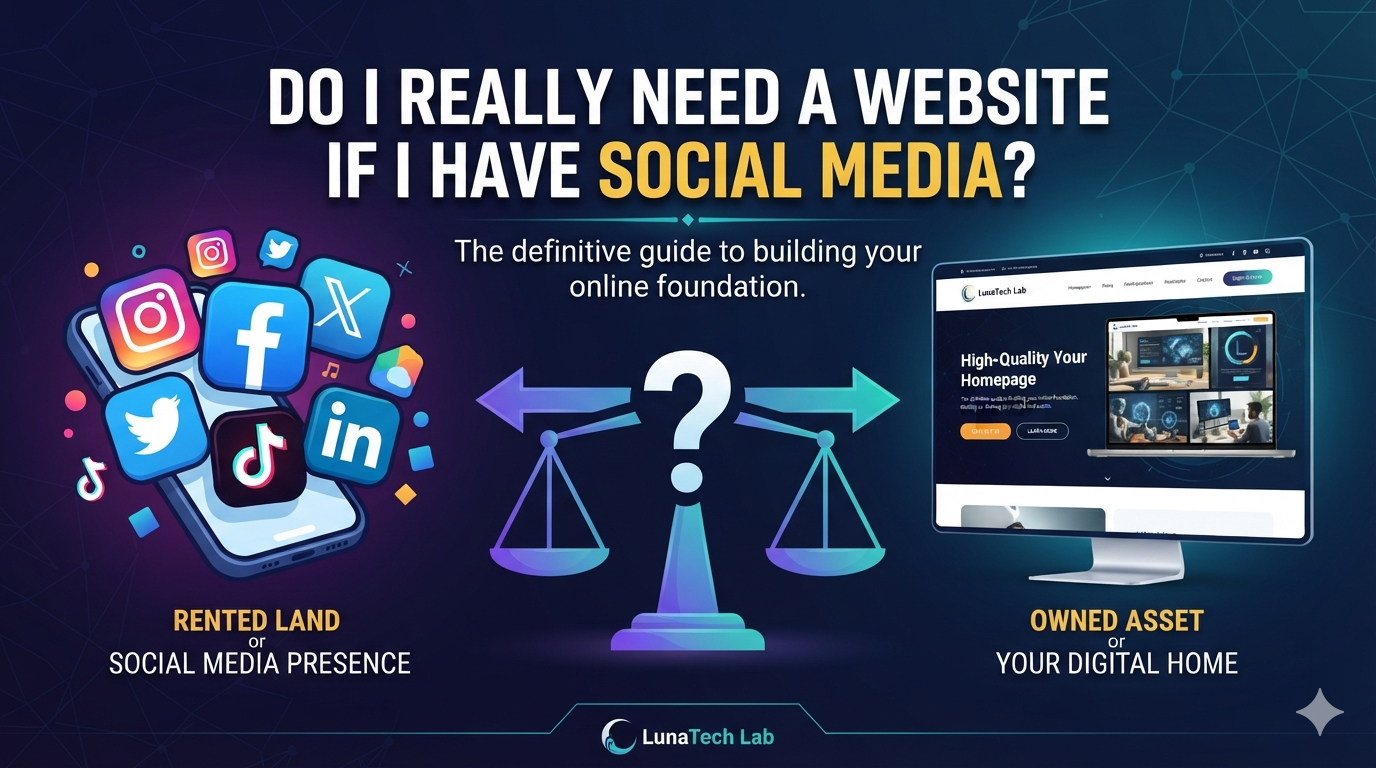
Every week, someone asks me some version of this question. A baker with 5,000 Instagram followers. A consultant with a LinkedIn audience. A boutique owner whose Facebook page gets steady engagement.
They've built something real on social media. And they're wondering: do I actually need a website too? Isn't that just extra work and money for something my customers won't even look at?
It's a fair question. Let me give you an honest answer — not the one a web developer is supposed to give, but the one that's actually true.
The short answer
Social media is brilliant at one thing: getting attention.
A website is brilliant at a different thing: earning trust and closing sales.
They're not competitors. They're different tools for different jobs. And if you're running a business, you almost certainly need both — but for very different reasons than most people think.
The real question isn't "website or social media?" It's "what is each one actually for?"
What social media does brilliantly
Let's give credit where it's due. A well-run social media presence can:
- Reach new people you'd never find otherwise
- Show personality in a way a static website can't
- Build a community around your brand
- Let you respond to comments and messages in real time
- Cost nothing to start
For a small business, that's genuinely powerful. If you're a local café posting daily specials, a photographer sharing client shoots, or a fitness coach posting workout tips — social media is exactly where your audience already is.
If you only did one thing, social media would be tempting.
But here's what most people don't realise until it's too late.
What social media can't do
You don't own it
Your Instagram account, your Facebook page, your TikTok profile — none of them belong to you. You're renting space on someone else's platform.
If Meta decides to shut down your account tomorrow (it happens, often by accident), or if the algorithm changes overnight, or if the platform itself dies (ask anyone who built on MySpace), everything you've built vanishes. You have no recourse. You have no backup. You have no copy of your customer list.
A website is the only piece of your online presence you actually own. Your domain, your content, your rules.
Social media is built for scrolling, not buying
Open Instagram right now. What do you see? A feed designed to keep you looking, not deciding. The entire interface is optimised for infinite browsing.
Now imagine a customer who's ready to buy. They want to:
- See your full range of services
- Check your prices
- Read your testimonials
- Find your phone number
- Know where you're located
On social media, that information is buried. It might be in a bio, a pinned post, a story highlight, a link tree, or a DM you have to send. Each step is friction. And friction kills sales.
A website puts everything a buyer needs in one place, organised for decision-making, not entertainment.
The trust gap is real
Here's a number worth sitting with: 84% of consumers say a business with its own website is more credible than one that only has social media[reference:0].
Another one: 31% of shoppers have decided against using a small business simply because it lacked a website[reference:1].
And perhaps most striking: 45% of consumers have actively walked away from a purchase because the business had no website[reference:2].
Think about what that means in practice. You could be doing everything right on social media — great content, real engagement, loyal followers — and still losing almost a third of potential customers before they even contact you. Not because of your prices or your service, but because they couldn't find a proper website to verify you're legitimate.
That's not a small leak. That's a hole in the bottom of the boat.
Organic reach is collapsing
If you've noticed that fewer people are seeing your posts lately, you're not imagining it.
Organic reach on major platforms has fallen to 1–4% of your followers in 2025[reference:3]. That means if you have 1,000 followers, only 10 to 40 of them actually see any given post.
Facebook and Instagram: around 4% organic reach. X (Twitter): around 3%. LinkedIn company pages: 1–2%[reference:4].
The platforms have become pay-to-play. Want your followers to see your posts? You'll need to pay for ads. And to make those ads work properly, you're looking at $1,500–3,000 per month in ad spend[reference:5].
That's not to say social media is worthless — it's not. But it's not the free marketing channel it used to be. And relying on it exclusively means paying rent forever just to reach people who already chose to follow you.
Social doesn't rank on Google
When someone searches "bakery near me" or "freelance web designer" or "yoga instructor in Dhaka," what comes up?
Almost always: websites. Not Facebook pages. Not Instagram profiles. Not TikTok accounts.
Search engines are built to surface websites. Your social media profile might appear when someone searches your exact business name, but it won't show up for the broader searches that bring in new customers[reference:6].
Every day, people are searching for exactly what you offer. If you don't have a website, you're invisible to them.
The honest counterpoint: when social media is enough
I want to be fair here, because this isn't a one-size-fits-all answer.
There are genuinely cases where a website isn't the right priority yet:
- You're testing an idea. If you're not sure whether your product or service has legs, spend three months on social media first. Validate demand before you invest in a site.
- Your business is 100% social by nature. If you're a content creator, a TikTok personality, or an influencer whose entire model depends on a specific platform, your social presence is your business.
- You're pre-revenue and every cent counts. A website doesn't have to be expensive, but if $200 is genuinely the difference between eating and not, it's fine to wait.
But here's the thing: almost everyone who asks this question isn't in one of those categories.
They're established. They have customers. They're just wondering whether they can skip the website part. And the honest answer is: you can skip it. But you'll pay for it in lost trust, lost credibility, and lost sales.
The real question: what job is each tool doing?
Instead of thinking about this as "website vs social media," think of it as a pipeline:
| Stage | Tool | Purpose |
|---|---|---|
| Discovery | Social media | Getting attention, reaching new people |
| Evaluation | Website | Building trust, showing credibility, explaining what you offer |
| Conversion | Website | Making it easy to buy, book, or contact you |
| Retention | Email + Website | Keeping in touch, bringing people back |
Social media is the top of the funnel. It gets people interested. But it's not built to handle the middle and bottom of the funnel — the part where someone decides whether you're worth their money.
A website is where that decision happens. It's your credibility anchor. It's the place people go to verify that you're real, serious, and worth hiring.
81% of consumers research a brand's website before making a purchase[reference:7]. If they look for yours and don't find it, what conclusion do they draw?
What this looks like in practice
Here's a realistic example.
A freelance photographer has 3,000 Instagram followers. She posts regularly, gets decent engagement, and books clients through DMs. She wonders if she needs a website.
Without a website:
- A potential client sees her Instagram, likes her work, and sends a DM asking for rates
- She replies with her prices
- The client says "let me think about it" and never responds
- She has no idea why
With a website:
- A potential client sees her Instagram, likes her work
- They Google her name or click the link in her bio
- They land on a clean portfolio site with pricing, testimonials, and a booking form
- They see she's legitimate. They see other people have trusted her. They see exactly how to work with her
- They book
The difference isn't that the website is prettier. It's that the website did a job Instagram can't do — it converted curiosity into confidence.
The minimum viable website
If the idea of building a full website feels overwhelming, start smaller.
You don't need 20 pages. You don't need a blog. You don't need custom animations.
You need:
- A homepage that says what you do, who it's for, and why you're credible
- A services or portfolio page that shows what you offer
- A contact page with your email, phone, or a form
- Your social links so people can follow you elsewhere
That's it. Four pages. A day's work for someone who knows what they're doing — and not much more for a template-based approach.
You can always expand later. The important thing is having a credibility anchor that works for you 24/7, doesn't depend on any platform's algorithm, and belongs entirely to you.
The bottom line
Social media and a website aren't competing options. They're different stages of the same journey.
Social gets attention. Your website earns trust. Together, they move someone from "who is this?" to "I want to work with them."
If you have social media but no website, you're driving traffic to a dead end. People arrive curious. They leave unconvinced.
You don't need a perfect website. You need a real one.
If you're not sure where to start, get in touch. I'll give you an honest answer about what your business actually needs — even if it's "not yet."
Need help building something?
If this post sparked an idea, I'd love to hear about it. I build clean websites and custom tools for small businesses.
Let's talk